
If you are leaving Mixpanel because of the bill but still need funnels, retention and cohorts on signed-in users, Amplitude is the closest replacement: the same events-and-users model, 2M free events a month, $720 at 10M events against Mixpanel’s $1,176 on monthly billing, and a built-in Mixpanel importer. If you only used Mixpanel to measure a website, you need cookieless web analytics instead, such as Plausible or invisit, with no cookie to put behind a banner. The short answer by reason, as of November 2026:
If you still need funnels, retention and user-level reports:
- The same product analytics for less at 5M to 20M events: Amplitude.
- Session replay, feature flags, experiments and SQL on one event stream, or self-hosting: PostHog.
- Everything autocaptured and billed by session instead of by event: Heap, now owned by Contentsquare.
- Open source and cheap, with retention, journeys and funnels on every plan: Umami.
- Cohorts, funnels and per-user profiles on your own servers: Matomo.
If you used Mixpanel to measure a website:
- Simple cookieless traffic stats from an EU company: Plausible.
- Cookieless site analytics with funnels, a record of every visit, AI referrals and revenue read from Stripe or Paddle: invisit, the tool we build.
Under 1M events a month, or with saved cohorts and warehouse sync in daily use, Mixpanel is still hard to beat. The last two sections cover when to stay and how to leave without losing your history.
Why do people look for Mixpanel alternatives?
People leave Mixpanel for one of two reasons. Product teams outgrow the price, because Mixpanel bills every event past 1M a month, autocapture adds events nobody chose, and history is deleted after 2 years. Marketing and content teams find they bought product analytics to answer website questions, with a cookie that needs consent in the EU.
The limits, from Mixpanel’s own pages and our own script measurement, as of November 2026:
- Price at volume. Mixpanel’s pricing is free up to 1M events a month. Past that, Growth costs $259 at 2M, $613 at 5M and $1,176 at 10M on monthly billing, about 29% less on yearly billing. On the Free plan, queries pause once a month passes 1M events, until you upgrade.
- Autocapture counts. Page views (
$mp_web_page_view) and autocaptured clicks, inputs, form submits and scroll checkpoints at 25, 50, 75 and 100% are all billable events (billing docs). A site with 300K page views and three autocaptured events per page view sends 1.2M events. - History. Mixpanel deletes events 2 years after the event date. Projects created before September 1, 2025 keep 5 years only until they change plan (export docs).
- Cookies. The JavaScript SDK keeps its distinct ID in a first-party cookie for 365 days.
disable_persistencestores nothing, but Mixpanel notes it also turns off super properties and the link from anonymous to identified users. - Region. Data is stored in the US unless you create a project with EU residency, and a project cannot change region later (EU residency).
- Weight. The SDK measured 33.5 KB gzipped on November 3, 2026, and session replay loads a 104.6 KB recorder on top (our measurements).
Who should stay on Mixpanel: a product team under 1M events a month gets unlimited seats, 10K session replays and retention reports for free. Growth adds saved cohorts and warehouse connectors, with Group Analytics as an add-on, and every plan has SDKs for iOS, Android, React Native and Flutter. Startups under five years old with up to $8M raised can get the first year free. If that describes you, the cheapest move is usually to stay.
What to look for in a Mixpanel alternative
Judge a Mixpanel alternative on what it bills, what you would give up, and what happens to your history. Seven points separate the tools below:
- The billing unit. Events (Mixpanel, Amplitude, PostHog), sessions (Heap), hits (Matomo), page views plus events (Plausible, invisit), or events plus each stored property (Umami). Check whether autocaptured clicks and page leaves count.
- Identified users. PostHog charges more for events from users you identify; Mixpanel and Amplitude charge the same either way.
- The reports you would lose: retention, cohorts, funnels that span days, user profiles, account-level analytics.
- Identity. A cookie ID that follows a user for a year, or a daily hash that never links two days (how they differ).
- Consent. A tool that stores an ID on the device generally needs consent in the EU and UK (what the law says).
- Your history. Whether the tool imports Mixpanel data, and how long it keeps data afterwards.
- Data location. EU hosting by default, chosen at signup, or chosen per project.
We checked every price and limit below against each vendor’s own pricing pages and docs on November 3, 2026.
Mixpanel alternatives compared: price, retention, cookies and imports
The first four alternatives keep Mixpanel’s product analytics model; Umami and Matomo are web analytics with product reports; Plausible and invisit are cookieless web analytics.
| Tool | Type | Billed by | 1M a month | 10M a month | Retention and cohorts | Cookie by default | Imports Mixpanel history | History kept |
|---|---|---|---|---|---|---|---|---|
| Mixpanel | Product analytics | Events | Free | $1,176 | Yes | Yes, 365 days | Not applicable | 2 years |
| Amplitude | Product analytics | Events | Free | $720 | Yes, cohorts on Plus | Yes, 365 days | Yes, every plan | 1 year Free, 2 years Plus |
| PostHog | Product analytics | Events | Free | $324 to $1,080 | Yes | Yes, 365 days | Yes, managed | 1 year free, 7 years paid |
| Heap | Product analytics | Sessions | Free to 10K sessions | Not published | Yes | Yes, 13 months | Not documented | 6 to 36 months |
| Umami Cloud | Web, with product reports | Events and properties | $20 | $200 | Yes, every plan | No | CSV on request, from Pro | 6 months to 5 years |
| Matomo Cloud | Web, with product reports | Hits | $204 | Quoted | Yes | Yes, 13 months | No | Raw data 24 months |
| Plausible | Web analytics | Page views and events | $69 to $139 | $169 to $339 | No | No | Aggregated CSV only | While you subscribe |
| invisit | Web analytics | Page views and events | $49 | $199 | No | No | No | Forever |
Prices are monthly billing in each vendor’s own unit, so they are not one for one.
PostHog’s range runs from all anonymous events to all events from identified users. Plausible’s runs from Starter to Business, the plan with funnels and custom properties. Matomo publishes Cloud prices up to 5M hits ($975) and quotes above. Heap shows the Growth price only after you install its snippet.
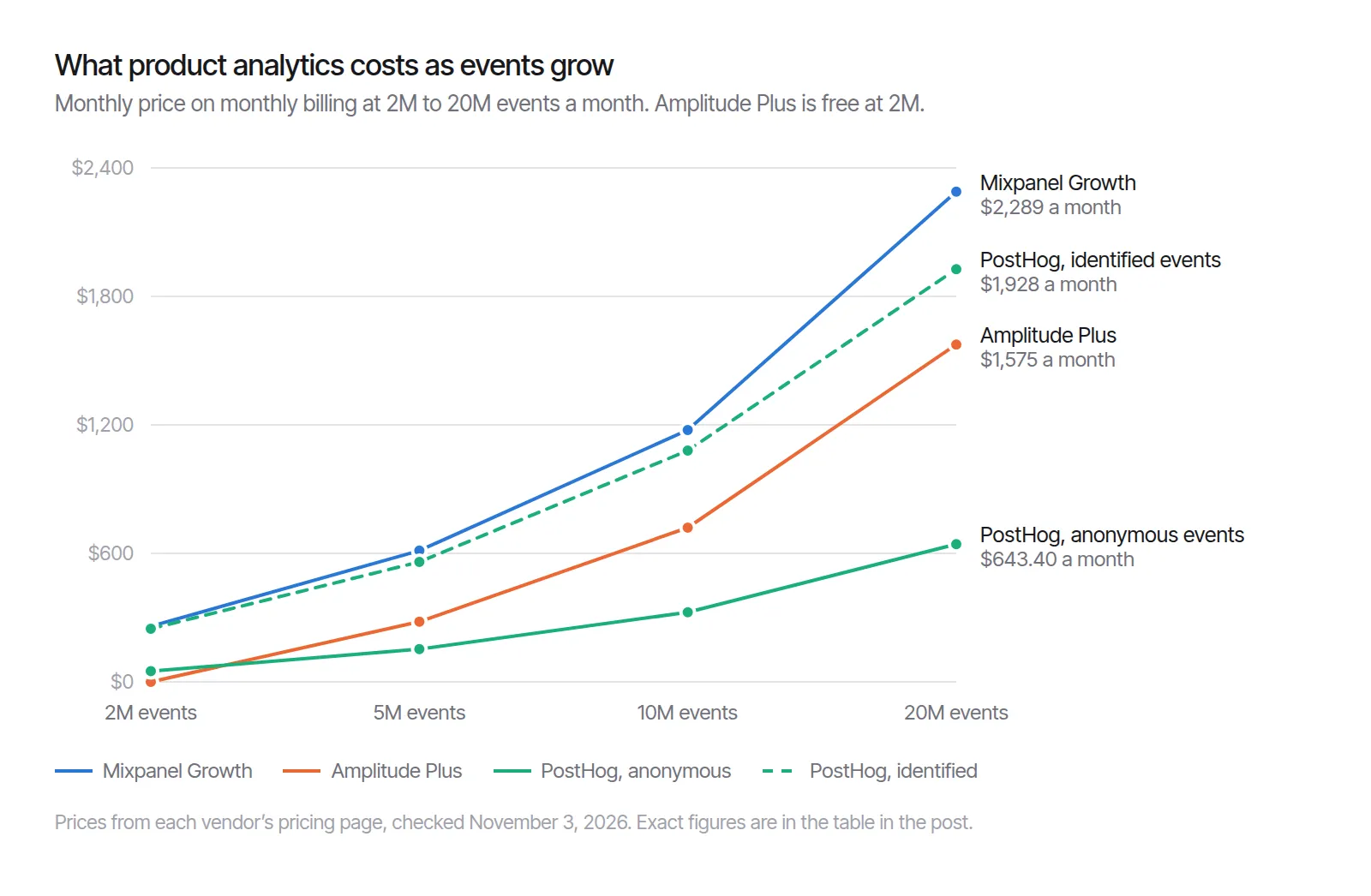
How much do Mixpanel, Amplitude and PostHog cost at 2M to 20M events?
At the same number of events, Amplitude Plus costs 31 to 54% less than Mixpanel Growth between 5M and 20M events a month. PostHog costs far less for anonymous events, but only 4 to 16% less than Mixpanel when every event comes from a user you identify, which is the normal case for a signed-in product.
| Events a month | Mixpanel Growth | Amplitude Plus | PostHog, anonymous events | PostHog, identified events |
|---|---|---|---|---|
| 2M | $259 | Free | $50 | $248 |
| 5M | $613 | $281 | $152.90 | $560 |
| 10M | $1,176 | $720 | $324.40 | $1,080 |
| 20M | $2,289 | $1,575 | $643.40 | $1,927.50 |
PostHog prices identified events as its product analytics rate plus an identified events add-on: $0.000198 an event from 1M to 2M and $0.0000697 up to 15M, on top of $0.00005 and $0.0000343 (PostHog’s pricing). We computed both PostHog columns from those published tiers. Amplitude’s figures come from the Plus calculator on Amplitude’s pricing page.1 Account-level reports cost extra on all three: Mixpanel’s Group Analytics adds 40%, Amplitude’s Accounts add-on adds $216 a month at 10M events on Plus, and PostHog bills group analytics per event.
The event count itself differs by tool, because each SDK sends different events by default:
| Tool | What a page view sends with the default setup |
|---|---|
| Mixpanel | $mp_web_page_view, plus clicks, inputs, submits and scroll checkpoints with autocapture on; identity calls and profile updates free |
| Amplitude | [Amplitude] Page Viewed, a Start Session and End Session per session, form starts and submits, file downloads; identify calls free |
| PostHog | $pageview and $pageleave, plus $autocapture for clicks on links, buttons and form fields |
| Heap | Nothing billed per event: Heap counts sessions, so autocaptured views, clicks, changes and submits do not raise the bill |
Sources: Amplitude autocapture and limits, PostHog’s dashboard docs, Heap’s pricing.
1. Amplitude: best for the same product analytics at a lower price per event
Amplitude is the closest like-for-like Mixpanel alternative: events tied to users, funnels, retention, cohorts and session replay, with unlimited seats on every plan. It costs less than Mixpanel at every volume in the table above and imports Mixpanel history on every plan.
Amplitude bills events. As of November 2026, the Free plan includes 2M events a month with no card. Plus also starts free for the first 2M, then costs $94 at 3M, $281 at 5M and $720 at 10M on monthly billing, or $576 a month billed yearly, up to 70M. Every ingested event counts, including the page views, session starts and ends, form events and file downloads Browser SDK 2 autocaptures by default; identify calls do not.
Amplitude does better than Mixpanel on price and on the free allowance, 2M events against 1M. Feature flags are unlimited on every plan, the EU data center is an option on every plan, and startups with under $10M raised and fewer than 20 employees get a year of Growth free.
Amplitude does worse in a few places. Behavioral cohorts start on Plus, at 20 per organization, Free caps saved charts at 10 per organization, and experiment results and SSO need Growth. Session replay stays at 10K a month on Plus, where Mixpanel Growth includes 20K. Free keeps 1 year of data you can query and Plus 2 years.
Over the Free limit three times, Amplitude blocks the account, and deletes it six months later if usage stays over without an upgrade (billing FAQ); on Plus, overage bills at your plan’s rate, and above 200% of your volume Amplitude may suspend the account (Plus terms). The AMP_ cookie lasts 365 days by default (cookies and consent).
Moving from Mixpanel is the easiest of the field. Since September 8, 2026, the Migrations panel under Data imports Mixpanel event data on every plan, EU data center included, and migrated events count toward your monthly event volume (self-service migrations). User profiles are not imported; Amplitude’s Mixpanel guide sends them through the Engage API and Amplitude’s Batch Event Upload API. In code, mixpanel.track becomes amplitude.track and mixpanel.identify becomes amplitude.setUserId.
2. PostHog: best for replay, flags and experiments on the same events
PostHog is the pick when you want more than Mixpanel in one tool: product analytics, session replay, feature flags, experiments, surveys and error tracking on one event stream, with SQL over raw events and an MIT-licensed edition you can host yourself.
PostHog bills events. As of November 2026, the first 1M events and 5,000 recordings a month are free; past that, anonymous events cost $0.00005 each up to 2M and $0.0000343 up to 15M, and identified events cost more, as the table above shows.
At 10M events that is $324.40 a month if they are anonymous and $1,080 if every one comes from an identified user. Seats are free. On the free plan, ingestion stops at the limit.
PostHog does better than Mixpanel on breadth, on price for anonymous traffic, and on history: 7 years of retention on paid plans (retention). The JavaScript library will feel familiar: the posthog-js license still carries Mixpanel’s 2015 copyright, because the library began as Mixpanel’s Apache-2.0 code, so register() for super properties and identify() work the way you expect.
PostHog does worse on weight and defaults. The array.js script measured about 119 KB gzipped, against Mixpanel’s 33.5 KB. posthog-js sets a 365-day cookie by default, and its cookieless mode keeps session replay and surveys off for visitors without consent (persistence). The self-hosted edition is unsupported and, in PostHog’s words, unlikely to scale past “a couple 100ks events” without significant effort.
Moving from Mixpanel: PostHog’s managed migrations connect to Mixpanel with a service account or project secret and import up to one year per job. They rename $mp_web_page_view to $pageview, apply no profile set updates, and do not deduplicate, so a restarted job imports twice.
Large histories go through an S3 bucket of Mixpanel JSONL instead. PostHog asks for a paid product analytics plan to run a migration, though historic imports are free (migration overview). See PostHog vs invisit.
3. Heap: best for autocapture without a tracking plan, billed by session
Heap captures every page view, click, input change and form submit automatically, and lets you define events afterwards over data already collected. Heap bills by sessions, not events, so autocapture never raises the bill the way it does on Mixpanel. Contentsquare completed its acquisition of Heap in December 2023 and has folded Heap’s features into its own Product Analytics, while existing Heap plans keep working (Contentsquare).
As of November 2026, Heap’s pricing has a Free plan up to 10K sessions a month with 6 months of history. Growth adds 12 months and CSV exports, with an estimate shown once you install the snippet; Pro and Premier are quoted. A web session ends after 30 minutes without a page view. Over the limit, Heap keeps collecting but you must upgrade before you can view your data again.
Heap does better than Mixpanel when your problem is instrumentation rather than price: no tracking plan to maintain, retroactive event definitions, and a bill that does not move when you capture more interactions.
Heap does worse on transparency and history. There is no public price above Free. Data history is 6 months on Free, 12 on Growth and up to 36 with a paid add-on on Pro or Premier, and data older than 37 months is deleted. Session replay and heatmaps are add-ons on Pro and Premier, region-specific storage is a Premier feature, and the heap.js cookie lasts 13 months minus a day (Heap’s cookies).
Moving from Mixpanel: Heap documents no import of Mixpanel events. Its historical data guide covers sending user properties through its APIs, so analysis starts on the day you install. In code, heap.track(name, props) and heap.identify(id) replace the Mixpanel calls, and heap.addEventProperties() plays the role of Mixpanel’s super properties.
4. Umami: best open-source option with retention, journeys and funnels on every plan
Umami is MIT-licensed web analytics with product reports: funnels, journeys, retention, cohorts, segments and goals on every plan, no cookies, and a self-hosted edition on Node.js and PostgreSQL. For a team that used a fraction of Mixpanel, Umami Cloud costs a fraction of it.
Umami bills events, and counts each stored event property as one more event, so umami.track('signup', { plan: 'pro' }) uses two. As of November 2026, Umami’s pricing is free to 100K events on Hobby (one site, 6 months of data), $20 for 1M on Pro (2 years) and $200 for 10M on Business (5 years), where heatmaps and 5,000 session replays a month are included.
Umami does better than Mixpanel on price, on consent, since it sets no cookies, and on script weight, about 4 KB gzipped. Self-hosting is free, with the same analytics as the cloud.
Umami does worse on identity and depth. Its visitor hash uses a salt that rotates monthly by default, so an anonymous visitor stays linkable for up to a month (visitor identification). It has no feature flags, experiments or account-level analytics, replays need Business, and property-heavy tracking can cost more than the page views.
Moving from Mixpanel: Umami’s team imports CSV data on request from Pro, and its import docs do not mention Mixpanel, so expect to convert your export. umami.track(name, data) takes up to 50 properties, and umami.identify(id, data) stores the ID as you send it. See Umami vs invisit.
5. Matomo: best for cohorts, funnels and user profiles on your own servers
Matomo On-Premise is free GPL v3 software you run yourself, and Matomo Cloud is the hosted version in Frankfurt. It is web analytics with Google Analytics depth plus User ID, visitor profiles, cohorts, funnels, heatmaps, session recordings and A/B tests, which covers much of what a Mixpanel user reads on a profile page.
Matomo bills hits: page views, events, downloads, outlinks and site searches, about 110 to 120 per 100 page views by Matomo’s estimate. As of November 2026, Matomo Cloud costs $204 a month for 1M hits and $975 for 5M, quoted above that. On-Premise is free, with premium plugins priced per year, such as Funnels at $239 and Cohorts at $99 for 1 to 4 users.
Matomo does better than Mixpanel when data must stay on infrastructure you run, and it adds scheduled email reports, official iOS and Android SDKs, and data kept in Germany on Cloud.
Matomo does worse on cost and consent. The tracker sets _pk_id for 13 months (cookie list), and the CNIL mode for consent-free tracking in France turns off the visits log, visitor profiles and User ID, the features a Mixpanel user wants most. Cloud has the highest published hosted price here at 1M, keeps raw data for 24 months, and self-hosting means PHP, MySQL and report processing on your own servers.
Moving from Mixpanel: there is no Mixpanel importer. Matomo’s Tracking HTTP API accepts past timestamps through cdt, with token_auth for anything older than 24 hours, and bulk requests in chronological order, so a script can replay an export. Mixpanel’s free-form properties have to fit trackEvent’s category, action, name and value, or custom dimensions. See Matomo vs invisit.
6. Plausible: best for simple cookieless traffic stats from an EU company
If Mixpanel was measuring your marketing site, Plausible replaces it with one page of traffic stats, no cookies, and data in Falkenstein, Germany, from a company whose providers are all European.
Plausible bills page views plus custom events. As of November 2026, Plausible’s pricing at 1M is $69 on Starter, $104 on Growth and $139 on Business, and at 10M $169, $254 and $339. Funnels, custom properties, revenue goals and the Stats API are on Business only. There is no hosted free plan; the trial is 30 days.
Plausible does better than Mixpanel on consent, on script weight (about 2.5 KB), and on marketing reports: Search Console queries, a Google Analytics 4 importer and scheduled email reports.
Plausible does worse on anything user-level. It has no user identification, retention or cohorts by design, and no view of a single visit (when not to use Plausible). A Mixpanel funnel that follows signed-in users through onboarding has no Plausible equivalent.
Moving from Mixpanel: Plausible’s CSV import takes aggregated daily tables, such as visitors, sources and pages, in its own format, so a raw Mixpanel export has to be summed into those tables first; events, properties and profiles do not carry over. mixpanel.track becomes plausible('Signup', { props: { plan: 'pro' } }), and identify has no equivalent. See Plausible vs invisit.
7. invisit: best for cookieless site analytics with funnels, visits and revenue
invisit, the tool we build, is web analytics for teams that used Mixpanel to answer website questions: where visits came from, which pages and events convert, what one visit did step by step, and what the site earned. It sets no cookies and stores nothing on the device; visitors are told apart with a hash whose salt changes every day and is then deleted.
invisit bills page views, custom events, conversions and short-link clicks. Bots, crawler reads, web vitals, engagement and identify calls are never billed. The Free plan covers 20,000 events a month on 4 sites without a card, and paid plans cost $14 for 100K, $49 for 1M, $99 for 3M and $199 for 10M (pricing). Data is kept forever.
invisit does better than Mixpanel for a website. There is no cookie to put behind a banner, and 10M events cost $199 instead of $1,176. Funnels run from pages or events, each visit can be followed step by step, live in Realtime and at any age through the REST API and MCP server, and heatmaps, web vitals, referrals from 19 AI assistants and crawler reads are built in. Revenue is read from Stripe, Paddle, Polar, Lemon Squeezy, Creem or Dodo Payments (connect a provider), and the script is about 8.5 KB against Mixpanel’s 33.5 KB.
invisit does worse on everything product analytics is for. There are no retention cohorts, session recordings, experiments, feature flags or mobile SDKs. Funnels have 2 to 8 steps within one visit, so a signup-to-activation journey over several days cannot be a funnel.
identify(user.id) attaches only a hash of your user id to visits, with no profile properties (what that changes). Revenue is not attributed to sources or visitors, there are no scheduled email reports, and invisit is hosted only.
Moving from Mixpanel: invisit cannot import history, so export it first. mixpanel.track('Signed Up', { plan: 'pro' }) becomes track('signed_up', { plan: 'pro' }), with names in letters, digits and _ . : - and up to 32 properties (events guide); page views need no call; purchase events give way to a payment provider connection. See Mixpanel vs invisit.
When should you stay on Mixpanel?
Stay on Mixpanel when your volume fits its free tier or your team depends on what only a product analytics tool does. Mixpanel is the better choice in these cases:
- You send under 1M events a month. Mixpanel is free with unlimited seats; among the hosted free plans above, only Amplitude’s is larger.
- You use saved cohorts, Flows and retention on signed-in users every week, and the move would cost more in rebuilt reports than it saves.
- You sell to companies and use Group Analytics for account-level reports.
- Your data lives in a warehouse. Mixpanel syncs from Snowflake, BigQuery, Databricks, Redshift and Postgres.
- You measure iOS, Android, React Native or Flutter apps alongside the web.
If price is the only problem, check what autocapture sends before you migrate. Scroll checkpoints and autocaptured clicks are billable, and the Mixpanel vs invisit page shows how three of them per page view move a 300K-page-view site past the free million.
How do you switch from Mixpanel without losing your history?
Export your Mixpanel history first, import it where the new tool allows, then run both tools side by side for two to four weeks before you remove the Mixpanel SDK. Mixpanel deletes events after 2 years, so an export protects older data whatever you decide.
- Export raw events with the Raw Event Export API. It returns JSONL with every property and the original timestamp, on every current plan, Free included, at up to 60 queries an hour, 3 a second and 100 concurrent per project. Use one request per date range:
#!/bin/sh
# Mixpanel allows 60 export queries an hour per project, so wait a minute per range.
# Use data-eu.mixpanel.com for an EU residency project.
EXPORT_HOST="data.mixpanel.com"
while read -r from to; do
  curl -sS --fail --compressed --get "https://$EXPORT_HOST/api/2.0/export" \
    -u "$SERVICE_ACCOUNT_USERNAME:$SERVICE_ACCOUNT_SECRET" \
    --data-urlencode "project_id=$PROJECT_ID" \
    --data-urlencode "from_date=$from" \
    --data-urlencode "to_date=$to" \
    -o "events_${from}_${to}.jsonl" || exit 1
  sleep 60
done <<'EOF'
2025-01-01 2025-01-31
2025-02-01 2025-02-28
EOF- Export user and group profiles with the Engage API, limited to 60 queries an hour and 5 concurrent (export all your data).
- Deduplicate before you load the files anywhere. Raw exports are not deduplicated; Mixpanel says to match on event name,
distinct_id, timestamp and$insert_id. Timestamps are UTC for projects created after January 1, 2023. - Import, if your new tool can: Amplitude’s Migrations panel or PostHog’s managed migration read straight from Mixpanel. For the other tools, keep the JSONL files as your archive.
- Map your tracking calls, using the table below, and install the new SDK next to Mixpanel.
- Compare both for two to four weeks. Visitor counts will differ: Mixpanel’s cookie recognises a visitor for up to a year, a daily hash for one day.
- Remove the Mixpanel snippet, then review the consent banner. Remove it only if nothing else on the page needs it.
| Tool | Instead of mixpanel.track(name, props) |
Instead of mixpanel.identify(id) |
Instead of register and people.set |
|---|---|---|---|
| Amplitude | amplitude.track(name, props) |
amplitude.setUserId(id) |
User properties through amplitude.identify() |
| PostHog | posthog.capture(name, props) |
posthog.identify(id) |
posthog.register(), posthog.setPersonProperties() |
| Heap | heap.track(name, props) |
heap.identify(id) |
heap.addEventProperties(), heap.addUserProperties() |
| Umami | umami.track(name, data) |
umami.identify(id, data) |
Session data in umami.identify(), billed as events |
| Matomo | _paq.push(['trackEvent', category, action, name, value]) |
_paq.push(['setUserId', id]) |
Custom dimensions |
| Plausible | plausible(name, { props }) |
No equivalent | No equivalent |
| invisit | track(name, props) |
identify(id), stored hashed |
No equivalent |
Before you remove the Mixpanel snippet
- Raw events exported for every project, in date ranges, and deduplicated on
$insert_id. - User and group profiles exported with the Engage API.
- History imported, if the new tool imports Mixpanel data, and a week of it spot-checked against Mixpanel.
- Every
track,identifyandregistercall mapped, with event names renamed where the new tool restricts them. - The funnels and retention reports you rely on rebuilt, or knowingly dropped.
- Both tools have run side by side for two to four weeks.
- The consent banner reviewed, and removed only if nothing else needs it.
Footnotes
-
Amplitude shows Plus prices in a slider on its pricing page. We read them from the calculator data that page loads, on November 3, 2026: $94 at 3M events, $281 at 5M, $720 at 10M and $1,575 at 20M on monthly billing. ↩